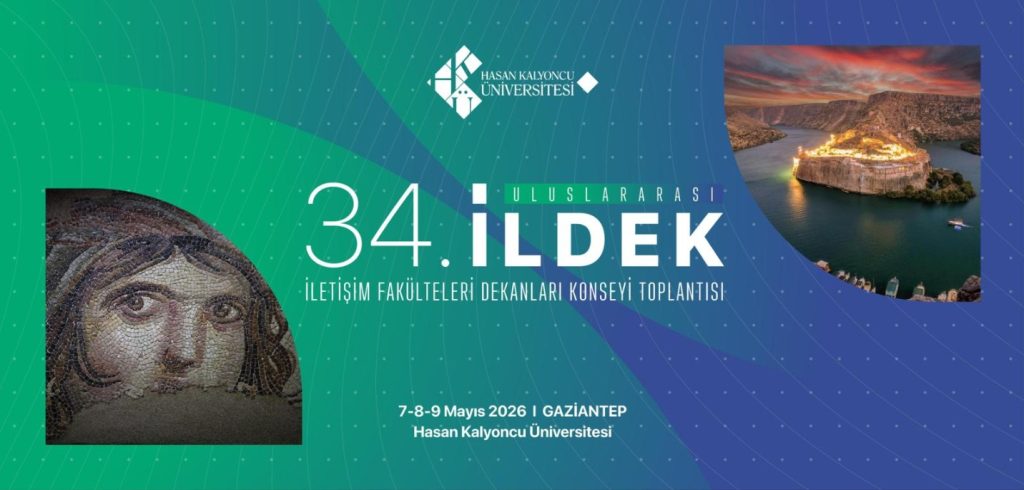
The 34th International Communication Faculties Deans Council (İLDEK) Meeting was held with broad participation between May 7 and 9, 2026, hosted by Hasan Kalyoncu University.
Bringing together representatives of academia, the sector, and public institutions, the meeting attracted attention with its sessions addressing the future of communication education in a multidimensional manner. In addition to the communication faculties in Türkiye, communication faculties from the Turkish Republic of Northern Cyprus participated in the meeting, with a total of forty-two communication faculties taking part.
The program’s first day began with the opening ceremony at the Law Auditorium of Hasan Kalyoncu University. Following a moment of silence and the Turkish National Anthem, promotional films of the university and the faculty were shown.
In the opening speech of the program, which began at the Hasan Kalyoncu University Law Auditorium, Prof. Dr. Gilman Senem Gençtürk Hızal, Chair of the İLDEK Executive Board, emphasized that they had adopted an approach that not only identifies existing problems but also shapes policies and decisions that will guide the future of communication education through an understanding of collective wisdom, participation, and cooperation. In her opening speech, Acting Rector and Dean of the Faculty of Communication Prof. Dr. Gül Rengin Küçükerdoğan said, “Bringing together our deans, academics, sector representatives, and decision-making institutions from different universities around the same table will contribute to our producing stronger solutions to the common problems of communication education. This meeting is not merely a council where we discuss existing problems and seek solutions; it is also a productive academic meeting platform where we create a common roadmap for the future, and this is extremely important for us as communication professionals.”
Arda Aşkın, Gaziantep Regional Director of the Press Advertisement Agency, stated that students’ learning about and adopting the personal rights granted to them under the Press Labor Law while they are still in school would provide important support in facing the difficulties they may encounter in their professional lives. Dursun Güleryüz, a Board Member of the Television Audience Research Committee (TİAK) and the Communication Research Association (İLAD), who took part in the meeting, stated that İLDEK meetings undertake a critical role in correctly understanding the transformation taking place in communication faculties, developing solutions that respond to current needs, and moving sector–university cooperation onto a stronger foundation.
Prof. Dr. Ümit Kocabıçak, President of YÖKAK, who participated in the program, drew attention to the fact that the artificial intelligence-oriented transformation directly affects the field of higher education and emphasized the importance of communication faculties reconsidering their curricula in line with new professions and changing sectoral needs.
THE PRESENT AND FUTURE OF COMMUNICATION EDUCATION WERE DISCUSSED DURING THE THREE-DAY PROGRAM
Within the scope of the three-day 34th İLDEK Meeting, panels and sessions titled “Academia–Sector Interactions,” “Artificial Intelligence and Content Production in the Media: Ethics, Opportunities, and Risks,” “Quality and Accreditation Processes of Communication Faculties,” “İLEDAK Institutional Information Workshop,” and “The Agenda of Our Science Communication Offices: New Professions and the Major Quota Transformation in Higher Education” were held. In addition, internship practices, curriculum transformation, artificial intelligence, infrastructure, and academic staffing issues were addressed under the title “Problems of Communication Faculties and Proposed Solutions.”
İpek Özgüden Özen, Chair of the Board of Directors of the Turkish Public Relations Association (TÜHİD), Zeynep Bortaçina Yener, President of the Advertising Foundation, Sibel Güneş, Secretary General of the Turkish Journalists Association, and Alper Tunga Özdemir, Vice Chair of the Board of Directors of the Film Producers Professional Association (FİYAB), participated in the session titled “Academia–Sector Interactions,” moderated by Prof. Dr. G. Senem Gençtürk Hızal, Chair of the İLDEK Executive Board. In the first panel of the meeting, the relationship between communication education and the sector was evaluated. In the panel, attended by representatives from the fields of advertising, public relations, cinema, and journalism, strengthening university–sector cooperation, increasing students’ practical experience, enabling sector professionals to teach courses, and professional transformation in the field of communication were discussed.
Within the scope of the program, a special session was also held on the quality and accreditation processes of communication faculties. In the session, in which YÖKAK President Prof. Dr. Ümit Kocabıçak was the speaker, the topics of quality assurance, accreditation culture, and sustainable development in higher education were discussed.
The final panel of the first day, titled “Artificial Intelligence and Content Production in the Media: Ethics, Opportunities, and Risks,” was moderated by Assist. Prof. Dr. Ceren Boz from Hasan Kalyoncu University. Prof. Dr. Deniz Yengin, Assoc. Prof. Dr. İhsan Eken, Assist. Prof. Dr. Batu Duru, and Assist. Prof. Dr. Bilge Kalkavan took part as speakers in the panel. During the session, the effects of artificial intelligence on media content production, ethical problems, disinformation, content reliability, and the transformation of new media practices were discussed from different perspectives.
Within the scope of the program, in addition to academic sessions, events focusing on culture, art, and science communication were also held. During the evening program on the first day, the opening of Assoc. Prof. Dr. Atiye Güner’s “Retrospective” exhibition, held at the Hasan Kalyoncu University Science Communication Office and Cultural House, took place. The exhibition opening, held in the historic Bey Neighborhood, offered participants the opportunity to experience the relationship between communication, art, and cultural production.
The second-day program began with the accreditation information workshop organized by İLAD–İLEDAK. At the “Institutional Information Workshop,” conducted by İLAD President Prof. Dr. Aysel Aziz and İLEDAK President Prof. Dr. Recep Tayfun, comprehensive information was shared regarding the accreditation processes, quality standards, and evaluation mechanisms of communication faculties. While comprehensive evaluations were conducted on the accreditation processes of communication faculties as part of the workshop, certificates were presented to the institutions that received accreditation in 2026.
In her speech titled “The Agenda of Our Science Communication Offices: New Professions and the Major Quota Transformation in Higher Education,” YÖK Press Advisor Çiğdem Savaşçıoğlu made evaluations regarding the changing student profile in higher education, new professional fields, and the transforming role of science communication.
In the afternoon,; two separate sessions were organized under the title “Problems of Communication Faculties and Proposed Solutions.” The first session was moderated by Prof. Dr. Hülya Önal. In the session, Prof. Dr. Pelin Hürmeriç addressed the use of artificial intelligence in public relations education, Prof. Dr. Gül Esra Atalay addressed the data- and artificial intelligence-oriented transformation in journalism education, Prof. Dr. Hasan Kemal Suher addressed the curriculum transformation of communication education, and Research Assistant Mahmut Ceran addressed the integration of artificial intelligence technologies into cinema education. The opportunities and risks created by digital transformation in communication education were comprehensively evaluated in the panel. The final session was moderated by Prof. Dr. Asaf Varol. In the panel, Prof. Dr. Ümit Arklan evaluated workplace-based education and internship practices, Prof. Dr. Rukiye Gülay Öztürk evaluated the structure of hourly-paid and full-time teaching staff, and Prof. Dr. Elif Asude Tunca evaluated the infrastructure and administrative personnel problems of communication faculties.
In the final part of the meeting, a presentation covering the activities of the İLDEK Executive Board was made. During the presentation, information was provided about the fifth CIDA Communication in the Digital Age Symposium, to be held by İLAD, İLDEK, and the Kocaeli University Faculty of Communication between October 15–17, 2026, under the title “The Transformation of Intelligence–The Dialectic of Communication.”
At the 34th International İLDEK Meeting, various decisions were taken regarding strengthening cooperation between communication faculties and professional organizations, increasing academia–sector interaction, and restructuring communication education in line with current transformations. While the effects of the artificial intelligence-oriented transformation on communication education were evaluated, it was emphasized that curricula should be updated, ethical principles and implementation procedures should be established, and new educational models prioritizing analytical thinking and strategic decision-making skills should be developed. In addition, a consensus was reached on expanding applied education processes, supporting workplace-based education models, eliminating infrastructure deficiencies and shortages of administrative and technical personnel, and reporting the opinions of internal and external stakeholders to YÖK. Within the scope of the meeting, various commissions were established to develop sector cooperation in the fields of public relations, advertising, journalism, new media, radio–television–cinema, and visual communication. It was decided that the request for student admission to communication faculties through the Equal Weight score type, in accordance with the knowledge, skills, and competency foundations of communication education, be submitted once again to the Council of Higher Education (YÖK), together with its justifications, for reconsideration and the implementation of the necessary regulations; that the necessary process be initiated for Yeditepe University Faculty of Communication to host the 2028 CIDA Symposium; and that the 35th International İLDEK Communication Faculties Deans Council Meeting be held at Fırat University in Elazığ.
The 2026 Communication Faculties Deans Council Executive Board was elected by the participants in the meeting. The Board, formed under the chairmanship of Prof. Dr. G. Senem Gençtürk Hızal, included Prof. Dr. Gül Rengin Küçükerdoğan, Prof. Dr. Ümit Arklan, Prof. Dr. Pelin Hürmeriç, Prof. Dr. Kenan Demirci, and permanent member Prof. Dr. Asaf Varol.